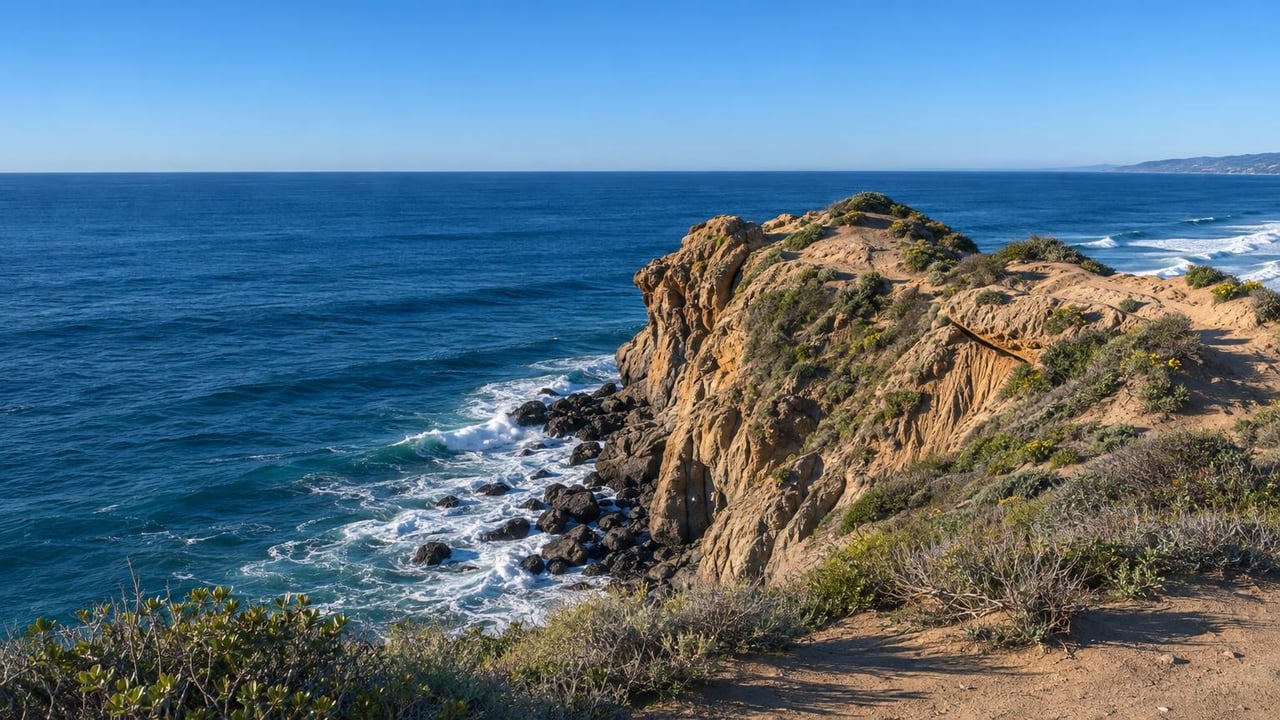
The boardwalk at the top of Point Dume ends at a viewing platform just below the summit, on the side that stays calmer when the wind picks up. On a clear day you can see all of Santa Monica Bay from there, plus the north Malibu coast, the Santa Monica Mountains and Catalina Island. California State Parks calls the headland a perfect place to watch California gray whales during the migration, which it dates from December to mid-April.
That window opens next week. This year, how you get up to the platform depends on which side of the point you start from. The bluff-top approach off Cliffside Drive is the same as always. The beach-side approach at the end of Westward Beach Road has been closed to vehicles since summer, while Los Angeles County rebuilds the shoreline that protects it.
The Summit Route Is the Same as Always
Parking at the top of Point Dume is free and limited to two hours. State Parks calls it extremely limited and says there is no parking in the residential areas around it. There is some disabled parking along Cliffside Drive next to the bluff-top park area, and the walk out to the viewing platform includes a slight grade.
Plan around the two-hour limit. Whale watching from a headland is mostly waiting, and two hours goes fast with binoculars and a thermos. Day-use parking runs sunrise to sunset, and dogs are not allowed in the park. If you have questions before you go, the park's listed number is (310) 457-8144.
State Parks' parking directions also point drivers to Westward Beach for overflow. This season that advice comes with a condition.
The Beach Route Is Walk-In Only for Now
The other way up Point Dume starts at sea level. The Point Dume Nature Preserve trail begins at the cul-de-sac at the end of Westward Beach Road. It climbs gradually to an ancient coastal bluff sand dune, and State Parks asks visitors to stay on the trail to protect the dune.
You can't drive to that cul-de-sac right now. In its November 16 notice, the City of Malibu said the access road at the end of Westward Beach Road "remains CLOSED to all vehicles." Pedestrians and cyclists may use the road except during active construction. According to the same notice, Westward Beach Road, Birdview Avenue and the beach itself are all open. The city asks beachgoers to watch for high water, erosion, rough surf and exposed rocks, and to stay clear of construction.
Thanksgiving weekend is the quietest time this month to walk in. The city's posted repair schedule ran through November 25 and listed no work from November 26 through 29. After that, the Los Angeles County Beaches and Harbors project page has the current construction information.
Bring water if you're coming from the beach side. The erosion also damaged the water lines to the public restrooms there. The county lists restoring water service to those restrooms as upcoming work.
Why the Shoreline Work Keeps Coming Back
The closure dates to July 31 and August 1, when severe erosion damaged the beach access road and the water lines serving the restrooms. Since then the county has worked in four stretches, which it labels Areas 1 through 4:
- Area 1, August 5 to 13: about 235 feet of emergency rock revetment to protect the access road.
- Areas 2 and 3, September 8 to October 23: about 230 feet of new revetment in Area 2, including 120 feet the City of Malibu requested to protect its right-of-way near the Westward Beach Road and Birdview Avenue intersection, plus about 230 feet of existing revetment repaired in Area 3.
- Area 4, starting November 7: repairs to about 325 feet of existing revetment along the access road, still in progress on the county's timeline.
The ocean kept pushing back between phases. As The Malibu Times reported on October 21, more erosion on October 19 undermined part of Westward Beach Road just west of the existing revetment and broke a county water main. Crews placed rock until midnight. The same report put the revetment project near Birdview Avenue at an estimated $766,025. The city is responsible for 70 percent, or $536,217.50, and the county for $229,807.50.
The city's notice names the causes as high tides, higher sea levels associated with El Niño conditions, and powerful waves since the summer. On November 9 the county finished protecting the Point Dume lifeguard building and two public restrooms. Engineers are still drawing up plans to repair the access road itself and improve stormwater drainage. That leaves walk-in access as the working arrangement on the beach side as whale season starts. Cliffside Drive is the route that lets you drive close to the overlook.
December and March Are Different Whale Seasons
The State Parks window runs from December to mid-April, and it covers both directions of the migration. NOAA Fisheries says the northbound migration begins in mid-February, and mothers with new calves travel last, between March and May. That means the early weeks at Point Dume come before the northbound movement starts, and the mother-and-calf pairs arrive late in the season, toward the end of the State Parks window.
The numbers behind those months have moved. NOAA's abundance estimate for the 2025/2026 season is 15,930 to 20,530 gray whales, compared with an estimated 11,700 to 14,200 for 2024/2025. The agency adds that changes in migration routes and survey and analysis factors can affect the counts. Calves are scarcer. NOAA estimated 85 calves in 2025, the lowest in its time series.
From the summit, the timing tells you when to spend your two hours at Cliffside Drive. December is the start of the State Parks window. Late February through March brings the northbound whales, and later in that stretch the mothers and calves.
When the Headland Is Full
Point Dume isn't the only public bluff on this coast. Robert H. Meyer Memorial State Beach is made up of three small beaches, El Matador, La Piedra and El Pescador, each with limited bluff-top parking and paths down to the sand. Farther up the coast, Leo Carrillo State Park on Pacific Coast Highway, 28 miles northwest of Santa Monica, is listed as open with restrictions. It has beach access and nature and wildlife viewing.
Watching from a boat this season means leaving Malibu. Boat tours from the Malibu Pier at 23000 Pacific Coast Highway are temporarily suspended, and the end of the pier is closed. State Parks expects pier repairs to finish by the end of January 2027 and says the reopening timeline will be decided after the repairs are evaluated. Our earlier look at the pier's recovery covers why the end has taken longer than the rest. Until it reopens, Marina del Rey Sportfishing runs whale-watching trips from Dock 52 at 13759 Fiji Way in Marina del Rey, and asks guests to check its reservation calendar for availability.
For a day without a boat, the plan is simple. Park on Cliffside Drive within the two-hour limit, take the boardwalk to the sheltered platform, and look out over the bay. If those spaces are full, you can walk in from the Westward Beach side over Thanksgiving weekend, when the construction schedule is clear.
Whale season is one of the ways the Point Dume coast changes through the year. Christopher Potter and the team at Potter Group work across Malibu from the Point Dume headland to the beaches farther up the coast. If a home within walking distance of the overlook is on your list, we're happy to talk it through.
