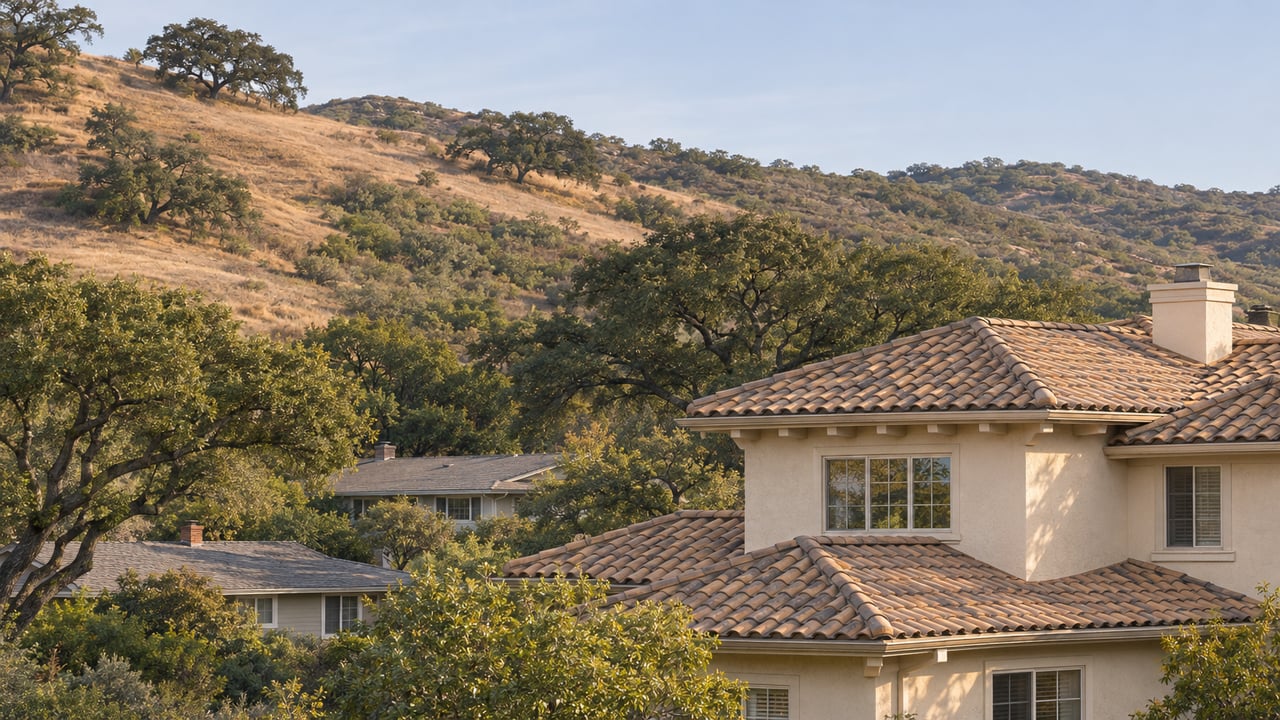
In 1967, the first Oak Park buyers could reach their homes by only one road. Metropolitan Development Corporation had built a two-lane extension of Kanan Road from the entrance of the Hillrise tract, and Oak Park Now's community history says there were no shopping centers, no other houses and no other streets between Hillrise and the new tract. The model homes went up on Kanan Road just north of what is now Mae Boyar Park. The sales brochure promised "a ten acre school site, six acre park, and 18 hole golf course already under development." The golf course was never built.
That first tract became the oldest layer of a community that went up one phase at a time over the next 35 years and then stopped for good. Ventura County's Oak Park Area Plan says Oak Park "built out 2002, and with no further development possible, the open spaces within and surrounding this community are forever dedicated parklands." Because Oak Park was built in sequence and has added no tracts since, where a house sits inside it says a lot about when it was built, who built it and what kind of home it was meant to be. Two Oak Park listings a mile apart can come from different decades of planning, and reading which decade is the first step in comparing them.
1967 and 1968: The Streets Named for Trees
The first unit sat on Kanan Road, Birchwood, Oakleaf, Pinewood, Tamarind and Satinwood. The second unit followed in 1968 on Maplegrove, Pinion, Bayberry and Smoketree. A third unit brought Oak Park's first two-story homes, on Pinion and Joshua. For years Kanan Road ended at Smoketree Avenue, so these streets were the whole community at first.
The original homes were sold differently from anything on the market now. Oak Park Now describes them as FHA Mutual Homes sold in groups of 20 to 25: a buyer entered escrow, and escrow did not close until every home in that group had sold. The original "Plan A" homes, known for their rock roofs, sold for $23,000. Down payments ran about $850, loans ran 35 years at 5.75%, and most monthly payments came to roughly $150 before taxes and insurance. The brochure listed underground utilities, street lights and wide sidewalks among the selling points.
For a buyer today, these tree-named streets mark the start of the community. A house there began as a late-1960s tract home, often single-story, and whatever it looks like now reflects the decades of owners since. An updated kitchen or added space in this part of Oak Park is work done after the fact, so ask for the dates and records of that work in the same way you would ask about any older home.
1974: The Year the Edges Were Drawn
The next layer of Oak Park follows a county decision more than a builder's plan. The Area Plan's chronology says MDC applied in May 1972 to develop the rest of the community, and the Board of Supervisors denied the application on April 24, 1973. A court judgment on December 30, 1974 then confirmed an agreement under which the county approved the Oak Park master plan, and MDC donated land for a fire station, a county administration building, school sites, parks and open space totaling more than 1,843 acres.
You can see the result of 1974 from almost any Oak Park street. The Area Plan covers about 869 acres, and the land donated for public use was more than twice that, so the hillsides around the homes are open space. A buyer touring here is looking at a set number of homes inside that ring of open land.
1974 to 1991: West of Kanan and North Toward Lindero Canyon
Between 1974 and 1991, the county approved development plans for each of Oak Park's four planning zones. Building spread to the west side of Kanan. Other developers took on land to the north and west, and Kanan was extended to meet the new Lindero Canyon Road extension and North Ranch. Building continued until Sutton Valley was full. These later phases also brought the apartments and condominiums the original single-family tracts lacked.
Shopping followed the same northward path. The original commercial center was a small strip at Sunnycrest and Kanan Road. The Oak Park Shopping Center later opened at the southeast corner of Kanan and Lindero Canyon Roads, and a third center opened on the northeast corner. The shopping centers trace the same path north as the homes, and the Kanan and Lindero Canyon intersection is roughly where the later phases begin.
This middle layer is where Oak Park's mix of home types widens. An Oak Park search that turns up a detached house, a townhome and a condo at very different prices is usually showing homes from different phases, each built for a different buyer. Our earlier piece on single-family versus townhome living in Oak Park covers that choice in more detail.
2002: Pardee, Deerhill Park and the Last New Homes
The final layer belongs to Pardee Homes. In September 2002, The Acorn reported that Pardee had built 168 Chambord homes and 147 Regency homes in the Deerhill Park area. One of the two Chambord models, a 4,010-square-foot, five-bedroom home with a bonus room, was listed just over $1 million. The final three phases of Chambord, about two dozen homes, were expected to finish by January, and four homes still for sale were listed between $689,000 and $845,000. The same article noted that Pardee had also built Oak Park's Monte Carlo, Monaco and Capri homes, and stated that "No other new homes will be built in the planned community."
The same 2002 Acorn article shows that resale prices were already climbing in older parts of the community: two existing homes in the Morrison tract of Sutton Valley had been advertised around $1 million, and one Sutton Valley home had sold for $980,000 earlier that year.
In 2002, then, Oak Park's newest homes and its established Sutton Valley resales were already selling in the same price range. The phase gives a buyer a starting point: the floor plans, lot layouts and type of home a particular builder put on those streets. Condition, updates and the specific lot come after that.
What a Finished Community Means When You Buy in 2026
Since build-out, Oak Park has not added new tracts, and the county plan leaves no room for more. Every home you tour here is a resale from one of the phases above, and Oak Park Now counts about 5,000 homes, apartments and condominiums across all of them. The supply comes from owners deciding to sell. No builder is adding to it, so how many choices you have in a given phase depends on how many owners in that phase list at the same time.
For broader context, the California Association of REALTORS September 2026 report put Ventura County's median price for existing single-family homes at $930,000 that month, up from $900,000 in September 2025, with countywide sales up 6.4% year over year. The same report showed a 3.5-month unsold inventory index and a median of 38.5 days on market across Ventura County in September 2026, compared with 3.8 months and 37.0 days a year earlier. Those are countywide figures for all of Ventura County, and Oak Park is a small, finished part of it. A county median mixes many towns and decades together. In Oak Park, a 1967 single-story on Birchwood and a 4,000-square-foot Chambord home near Deerhill Park are both in that mix, which is why the useful comparison for any Oak Park listing is with recent sales from its own phase.
The open space that fixed Oak Park's size also shapes many of its lots. Rancho Simi Recreation and Park District describes the Medea Creek Trail and Natural Park as running south of Kanan Road and north of Conifer Street, with access from Medea Creek Lane, Conifer Street, Oak Hills Drive and Kanan Road, and the district notes that its trail segments generally run beside housing. Oak Canyon Community Park, just north of Kanan Road and reached from Hollytree Drive or Bromely Drive, has a splash pad, pavilions, a playground and a walking path. Two homes from the same phase can sit very differently against that open space. Within a phase, the lot is often what separates one listing from another, so check what each home backs onto when you tour. For the district's current park projects, see our post on Oak Park's park upgrades and the budget behind them.
Frequently Asked Questions
Will any new homes be built in Oak Park? The Ventura County Oak Park Area Plan describes the community as built out in 2002 with no further development possible, and the surrounding open space is dedicated parkland.
Who built Oak Park's newest homes? Pardee Homes built the final tracts, including 168 Chambord and 147 Regency homes in the Deerhill Park area, along with the Monte Carlo, Monaco and Capri homes, according to The Acorn's 2002 report.
Why do some older records list Oak Park under 91301? Oak Park originally shared the 91301 ZIP code with Agoura and later Agoura Hills, both in Los Angeles County. It received its own ZIP code, 91377, on January 1, 1999.
If you're weighing an Oak Park home and want to talk through which phase it comes from and what that means for your offer, Potter Group would be glad to walk those streets with you. If you already own here and want to know where your phase stands in today's market, start with a home valuation or visit our Oak Park neighborhood page. Work With Us.
